
Have you ever felt an overwhelming sense of inadequacy when faced with a daunting task? Many have. The story of Moses in the Bible powerfully illustrates how God equips the seemingly unqualified for His grand purposes. In this article, we will explore who Moses is, his significant role in Scripture, and how his life reflects God’s faithfulness.
Understanding Moses is essential for grasping important biblical themes about God’s covenant, deliverance, and leadership. His life not only reveals God’s character but also serves as an inspiration for believers seeking to follow God’s calling on their own lives.
Who Is Moses In The Bible?
Moses is a central figure in the Bible, revered as a prophet and leader who guided the Israelites out of slavery in Egypt. He authored the first five books of the Bible, known as the Pentateuch, and is a pivotal character in Judaism, Christianity, and Islam.
Moses’ Early Life
Moses was born into a Hebrew family during a time when Pharaoh had ordered the death of all newborn Hebrew boys. To save him, his mother placed him in a basket on the Nile River. Pharaoh’s daughter discovered him and raised him in the royal palace (Exodus 2:1-10).
Despite enjoying privilege, Moses identified with his Hebrew heritage. One day, he witnessed an Egyptian beating a Hebrew slave and, in a moment of rage, killed the Egyptian. Fearing the consequences, he fled to Midian, where he spent years tending sheep and building a family (Exodus 2:11-15).
The Burning Bush Encounter
Moses’ life took a dramatic turn when he encountered God in the form of a burning bush on Mount Horeb (Exodus 3:1-6). Here, God called Moses to lead the Israelites out of bondage in Egypt. This moment marked a significant turning point, as God revealed His name, “I AM WHO I AM,” emphasizing His eternal and self-sufficient nature.
Have you ever felt God nudging you toward a challenge? Imagine the feelings Moses experienced in this encounter—fear, unworthiness, and confusion. Such was the battle Moses faced initially.
Moses hesitated to accept God’s call. He doubted his speaking ability and questioned why the Israelites would listen to him (Exodus 3:11-13). Despite his excuses, God assured him of His presence and power (Exodus 3:14-22).
Moses offered further objections, including, “Oh, my Lord, I am not eloquent…” (Exodus 4:10). God responded by empowering Aaron, Moses’ brother, to be his spokesman. This illustrates a profound truth: God knows our weaknesses yet chooses to use us for His purposes.
Moses returned to Egypt with God’s promise of deliverance. He confronted Pharaoh, demanding the freedom of the Israelites. Pharaoh’s hardened heart led to ten devastating plagues (Exodus 7-12), showcasing God’s power over Egyptian gods and ultimately leading to the liberation of the Israelites.
The final plague—the death of the firstborn—resulted in the institution of the Passover, where the blood of a lamb marked the homes of the Israelites, sparing them from destruction (Exodus 12:1-13).
The Exodus and Crossing the Red Sea
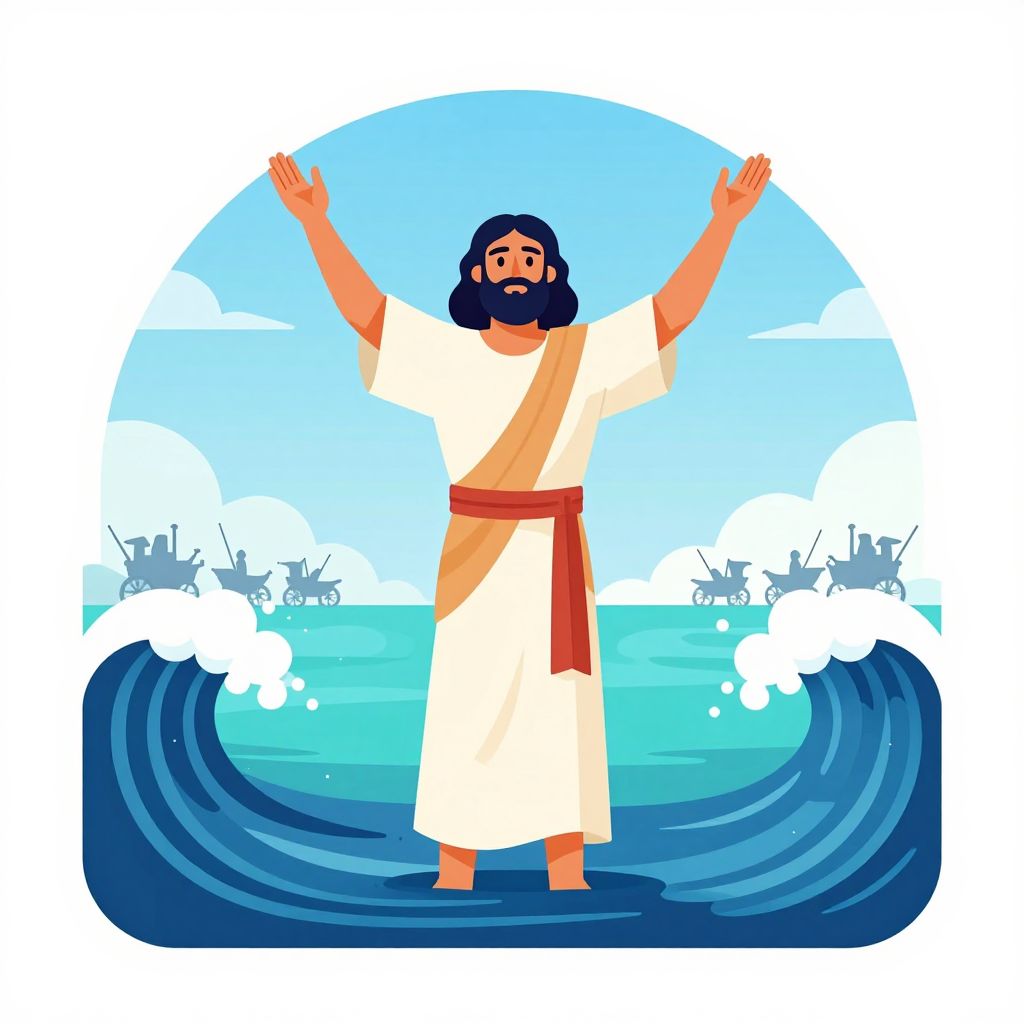
The climax of Moses’ leadership occurred during the Exodus. God led the Israelites out of Egypt, guiding them with a pillar of cloud by day and fire by night (Exodus 13:21-22). When they reached the Red Sea, they faced seemingly insurmountable obstacles. The Egyptians pursued them, leading to a tense moment of fear and despair.
In Exodus 14:13-14, Moses declared, “Do not be afraid. Stand firm and you will see the deliverance the Lord will bring you today.” God instructed Moses to stretch out his hand over the sea, and the waters parted, allowing the Israelites to cross on dry ground. This miraculous event displayed God’s omnipotence and his commitment to His people.
After the Israelites escaped Egypt, they began a challenging journey through the wilderness. God provided manna and quail to sustain them (Exodus 16:4-15). He also brought water from a rock when they complained of hunger and thirst (Exodus 17:1-7).
During this time, God revealed Himself to Moses on Mount Sinai, giving the Ten Commandments (Exodus 20). These laws were to guide the Israelites in their relationship with God and with each other, emphasizing the importance of holiness and community.
Moses exemplified servant leadership. Despite the burdens of leading a stubborn and often grumbling people, he interceded on their behalf when they sinned (Exodus 32:30-32). His willingness to advocate for the people reflects a heart aligned with God’s mercy.
In Numbers 12:3, the Bible notes that Moses was “very humble—more humble than anyone else on the face of the earth.” His leadership style demonstrated reliance on God’s guidance rather than personal ambition, showcasing true faith in action.
Moses faced immense challenges during the forty years in the wilderness. The people complained and rebelled against his leadership, leading to significant moments of discouragement (Numbers 11:1-3). Their murmuring tested Moses’ patience, revealing his humanity.
At times, Moses became frustrated, and in one incident, he struck a rock to bring forth water instead of speaking to it, as God commanded (Numbers 20:10-12). This act of disobedience cost him the privilege of entering the Promised Land, reminding readers of the importance of following God’s instructions exactly.
Moses’ life came to an end on Mount Nebo, where God allowed him to see the Promised Land but forbade him from entering it (Deuteronomy 34:1-4). His legacy continued through the people he led, the laws he passed down, and in the words of Jesus, who affirmed Moses’ central role in biblical history.
The New Testament frequently refers to Moses. In Luke 9:30-31, Jesus is transfigured and speaks with Moses, highlighting the continuity between the Old and New Testaments. Moses represents the Law, while Jesus embodies grace and truth (John 1:17).
Moses in the New Testament
Moses’ significance does not end with the Old Testament. He is referenced numerous times in the New Testament, each mention highlighting his role as a forebear to Christ and a paragon of obedience and faithfulness.
The Law and Prophets
When Jesus came to fulfill the law, He emphasized that not one detail of the Law given through Moses would disappear until all is accomplished (Matthew 5:17). This intertwining of Moses’ teachings and the message of Jesus underscores the continuity of God’s plan for redemption.
Moses as a Type of Christ
Theologians often view Moses as a type of Christ. Just as Moses delivered the Israelites from slavery, Jesus delivers all believers from the bondage of sin and death. Moses became a mediator between God and Israel, while Jesus serves as the ultimate mediator between God and humankind (1 Timothy 2:5).
Moses’ life offers profound lessons for believers today. Some of these include:
- God chooses unlikely candidates to fulfill His purposes.
- God equips us with the resources needed to complete His calling.
- Faith requires obedience even amid uncertainty.
- Leadership is marked by humility and reliance on God.
Applying the Lessons of Moses
What can believers learn from Moses’ experiences? Here are some practical steps for applying his lessons to our own lives:
- Assess if you feel unqualified for God’s calling. Let Moses’ story remind you that God often uses the weak to show His strength.
- Identify ways God has provided for you in the past. Reflect on how His faithfulness can help you trust Him moving forward.
- Obey God even when the path is unclear. Take that first step in faith, knowing He will guide the way.
- Practice humility in leadership. Be willing to accept feedback and guidance from others, positioning yourself as a servant.
Conclusion
Moses stands as a monumental figure in the Bible, embodying God’s faithfulness, power, and the complexities of human leadership. His story reveals God’s relentless pursuit of humanity and His desire to involve ordinary people in extraordinary tasks. Through Moses, God invites us to step into our roles with courage, faith, and humility.
What role is God calling you to in your life? Reflect on Moses’ journey as you seek to answer that question. Let your response be marked by a commitment to obedience and a heart open to God’s leading.
For more insights on biblical figures and their lessons, consider exploring topics like Who Is Melchizedek In The Bible and other faith-oriented articles at Bible Truth for Today.